

The Big Easy Study Tour of New Orleans
THURSDAY, OCTOBER 22–SUNDAY, OCTOBER 25, 2026
October 22–25, 2026
$4300 pp/double, $650 single supplement
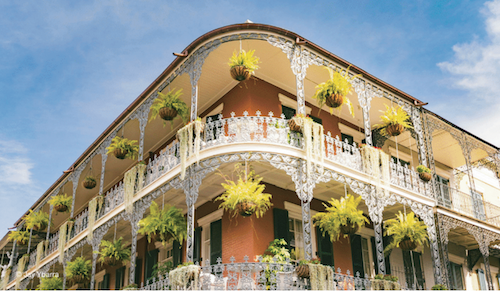
Few American cities rival the allure of New Orleans—a place where centuries of history, architecture, music, cuisine, and cultural traditions converge in a setting unlike anywhere else in the country. This fall, Charles Chamberlain and Stephen Fox invite you to experience the city through a carefully curated program designed to reveal both its celebrated landmarks and lesser-known treasures.
From Creole culinary traditions and legendary jazz venues to historic neighborhoods, private homes, and significant cultural institutions, this four-day immersion offers a richly layered introduction to the incomparable spirit of New Orleans. Guests will be based at the elegant Windsor Court Hotel, ideally situated for our explorations.
Study tour cost includes meals as specified in the itinerary, accommodation, admission fees, and guides. Travel to and from New Orleans is not included, including airport transfers.
Suggested Outgoing Flights 10/22:
United 491 dep. IAH 7:30 A.M. arr. MSY 8:45 A.M.
Suggested Return Flights 10/25:
United 1396 dep. MSY 6:45 P.M. arr. IAH 8:15 P.M.
Click Here for Registration Forms
Study Tour Itinerary (Subject to Change)
Thursday, October 22 Arrival & The French Quarter
Guests are asked to make individual flight arrangements and transfers to the Windsor Court Hotel.
– 11:30 AM Our program begins as we gather in the Windsor Court Hotel lobby and stroll to Drago’s Seafood Restaurant for an introduction to one of the city’s most beloved culinary traditions: the legendary charbroiled oysters created by Tommy Cvitanovich.
– This evening, we reconvene for dinner at the celebrated Brennan’s, where the story of Bananas Foster—created in 1951 by Ella Brennan and Paul Blangé—offers a delicious lens into the city’s historic banana and coffee trade.
-After Dinner (optional): Guests wishing to continue the evening may enjoy live jazz in the Windsor Court Polo Club Lounge or independently visit Mahogany Jazz Hall.
– Dinner will be at the legendary Dooky Chase’s Restaurant, a landmark of New Orleans culture, hospitality, and civil rights history since 1941.
– Our final afternoon explores the vibrant Faubourg Marigny, where French, Spanish, and Caribbean influences have shaped one of the city’s most colorful and artistic districts.
– The program concludes with a self-guided visit to the New Orleans Jazz Museum located in the US Mint Building.
– 4:00 PM Departure by bus from the Windsor Court for the airport.
We look forward to sharing this extraordinary city with you.
Our guides:
Dr. Charles Chamberlain is a professor of history at the University of New Orleans, concentrating on Louisiana studies and music history. He received his PhD in U.S. History from Tulane University in 1999, and is the author of New Orleans: A Concise History of an Exceptional City (LSU Press, 2025). Chamberlain has worked as a museum professional, curator, and consultant on numerous exhibits throughout Louisiana and Mississippi. Since 2014, Dr. Chamberlain has served as a licensed tour guide for the City of New Orleans, and he specializes in developing and presenting cultural tourism globally. As an active musician, he performs a variety of styles encompassing jazz, blues, American roots, and traditional French music.
Stephen Fox
Stephen Fox is an architectural historian and a lecturer at the Rice University School of Architecture. He is also a lecturer at the Gerald D. Hines College of Architecture at the University of Houston and a fellow of the Anchorage Foundation of Texas. Fox’s work is focused on architecture of the nineteenth and twentieth centuries, especially that of Houston and Texas. In his scholarship, he examines the ways that architecture engages such social constructs as class identity, cultural distinction, and regional differentiation. Fox is the author of the AIA Houston Architectural Guide, The Country Houses of John F. Staub, and is a contributor to the Society of Architectural Historians’ The Buildings of Texas: Central, South, and Gulf Coast, edited by Gerald Moorhead. He has contributed chapters to The Open-Ended City: David Dillon on Texas Architecture, edited by Kathryn E. Holliday; Victor Lundy: Artist Architect, edited by Donna Kacmar; and Avant-Garde in the Cornfields: Architecture, Landscape, and Preservation in New Harmony, edited by Ben Nicholson and Michelangelo Sabatino. Most recently, his writing can be found in Making Houston Modern: The Life and Architecture of Howard Barnstone, edited by Barrie Scardino Bradley and Michelangelo Sabatino.
Please note: study tour price does not include travel to and from New Orleans.
If you have any questions, please email [email protected] or call (713) 666-9000.
TRAVEL REGISTRATION AND CANCELLATION POLICY
Reservations will be made on a first come-first served basis upon receipt of a $500 deposit, the Reservation and Deposit Form, and the signed Release of Claims form. Payment in full is due on August 22, 2026. Reservations received after August 22, 2026. may be accepted if space is available and payment is made in full. Your reservation is not confirmed until you have received written confirmation from the Houston Seminar.
If payment in full for the tour is not made by August 22, 2026, your reservation will be canceled, and your $500 deposit will be forfeited. Should the Houston Seminar cancel the tour for any reason, your deposit and any additional payments will be refunded in full. Should you have to cancel for any reason, you must notify the Houston Seminar in writing. For cancellations before August 22, 2026 all payments, less the $500 deposit, will be refunded. A cancellation between August 22, 2026 and September 22, 2026, will result in the forfeiture of your $500 deposit plus 50% of all other amounts paid. After September 22, 2026, cancellation will result in the forfeiture of 100% of all amounts paid. We recommend that you consider purchasing travel insurance.
Related products
-
Leading Lights in the New Poetic Vanguard
-
Houston Collects, October 13
$60.00 -
From Poverty to Prosperity: The Real Energy Transition
-
Ethical Choices Relating to War and Crisis, May 11
$35.00